Student-led
VRT brings together students from the School of Engineering and the Business Team Academy of HES-SO Valais-Wallis. We run like a real motorsport structure, with leadership, finance, logistics and communication roles.

Formula Student, our team, our association
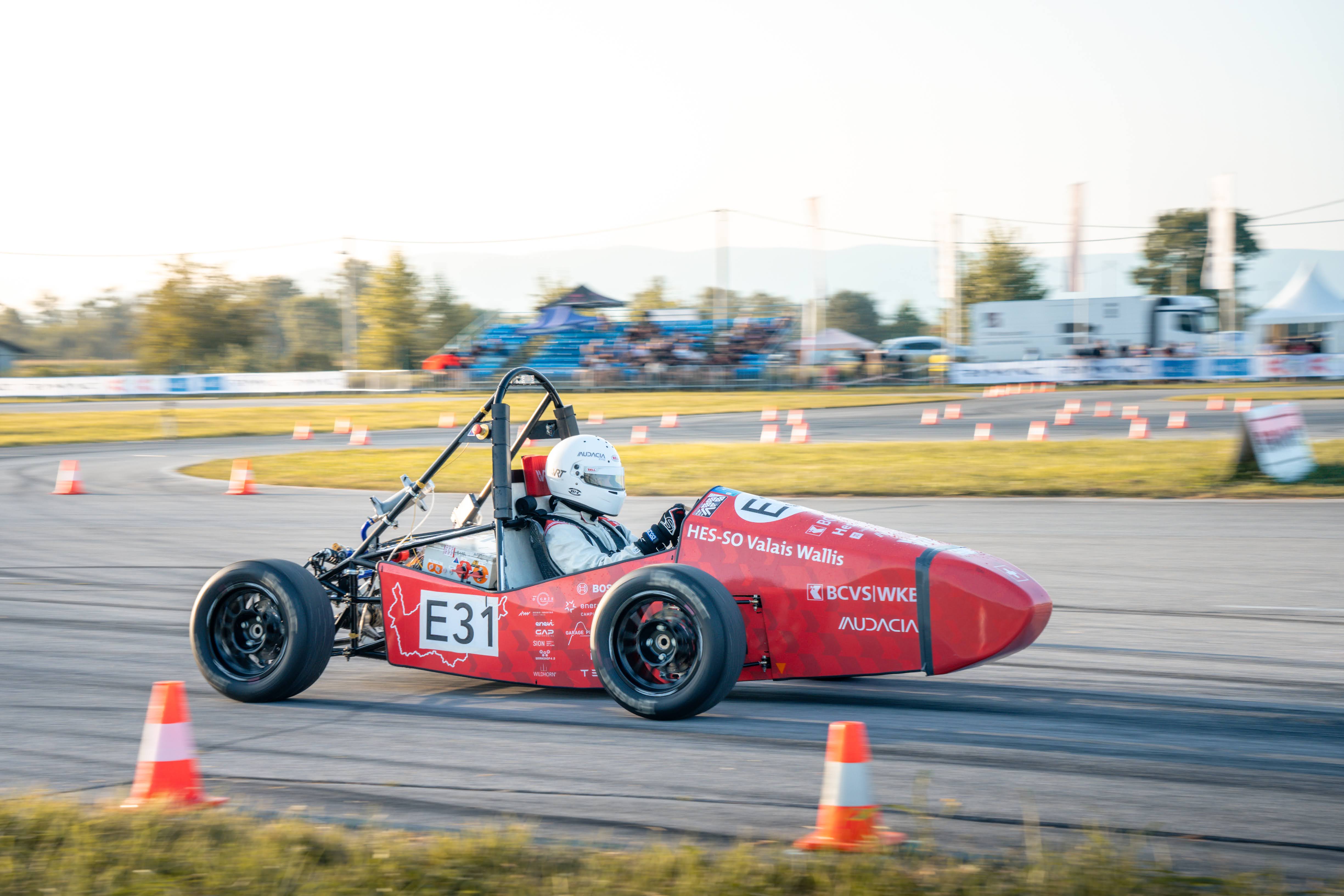
Born in 2022, the Valais/Wallis Racing Team is the HES-SO Valais-Wallis student association that designs and builds one fully electric formula car per season. Four cars, dozens of trained students and a string of European paddocks later, this is our story.
From an idea to European circuits
Students from HES-SO Valais-Wallis launch the project: build the first Formula Student car from Valais.
First car, first season: inspections cleared in record time and a top 5 in endurance and efficiency at FS Spain.
The team grows to 37 members, gains 12 kW of power and partners with Imperix to test its motor off track.
Best season so far: 11th at FS Switzerland, three European competitions and the first SwissGP in Vauffelin.
The fourth car is in design, carried by a new generation of members and a growing Driverless group.
The Valais/Wallis Racing Team association
Behind this story stands an organization: launched in 2022 and incorporated as an association in 2023, VRT passes its knowledge from one generation of students to the next, from its workshop on the Energypolis campus in Sion.
VRT brings together students from the School of Engineering and the Business Team Academy of HES-SO Valais-Wallis. We run like a real motorsport structure, with leadership, finance, logistics and communication roles.
Our main departments are Mechanical, Electrical, IT and Business & Promotion, joined by a Driverless group. Design, manufacturing, software, testing and communication converge on a single vehicle platform.
Train future engineers through a full-cycle project while representing Valais at international events. Our partnerships with local schools, companies and institutions sustain the project year after year.
The competition we race in
Formula Student grew out of Formula SAE, launched in the United States in 1981 by the Society of Automotive Engineers. Its European counterpart, run by the IMechE since 1998, has become the largest student engineering competition in the world.
Teams design, build and race a single-seater within one year. It is not just about speed: engineering quality, cost control and the business plan count as much as the stopwatch, for a total of around 1000 points.
Each team runs like a young engineering company: technical choices to defend in front of judges, trade-offs to justify, risks to manage and a concept to prove safe and competitive.
Static and dynamic events
At official competitions, held each summer across Europe and beyond, every car is judged on two complementary fronts.
Engineering Design, Cost & Manufacturing and Business Plan: teams defend their technical choices, cost report and business strategy in front of industry engineering judges.
75 m acceleration, skidpad, autocross, a 22 km endurance run and energy efficiency: five timed events that validate the car's reliability and real-world performance.
One season, multiple milestones
From October to August, every season follows the same thread: earn your slot, pass the checks, score points and pass on what you learned.
Teams secure competition slots and submit preliminary documentation months before summer events.
At the event, every car goes through inspections: mechanical and electrical checks, tilt test, rain test and brake test before it is allowed on track.
Static and dynamic disciplines award points that reflect both engineering quality and track performance.
After each competition, teams analyze results, document lessons learned and prepare the next generation car.
The gate before the track
Before competing, teams must pass Formula Student quizzes and rule checks. This step verifies engineering knowledge and regulation compliance, ensuring a high competition standard. For teams, quiz days feel like final exam results: high tension, high expectations, and a strong learning curve.
Beyond the car
From CAD to validation, members gain hands-on technical competence.
Complex decisions are taken across disciplines and deadlines.
Budgeting, planning, sponsorship and communication are integral.
Members graduate with proven project delivery experience.